
Agents You Can Verify: Infrastructure and standards for sovereign enterprise AI
Over 75 people braved the storms in San Francisco to join us at the AWS Builder Loft for this event. Thanks to our own Miguel Solari taking the lead on organizing this wonderful event, bringing these high-caliber guests together and emceeing the evening. We present Miguel's thoughts on the event below.
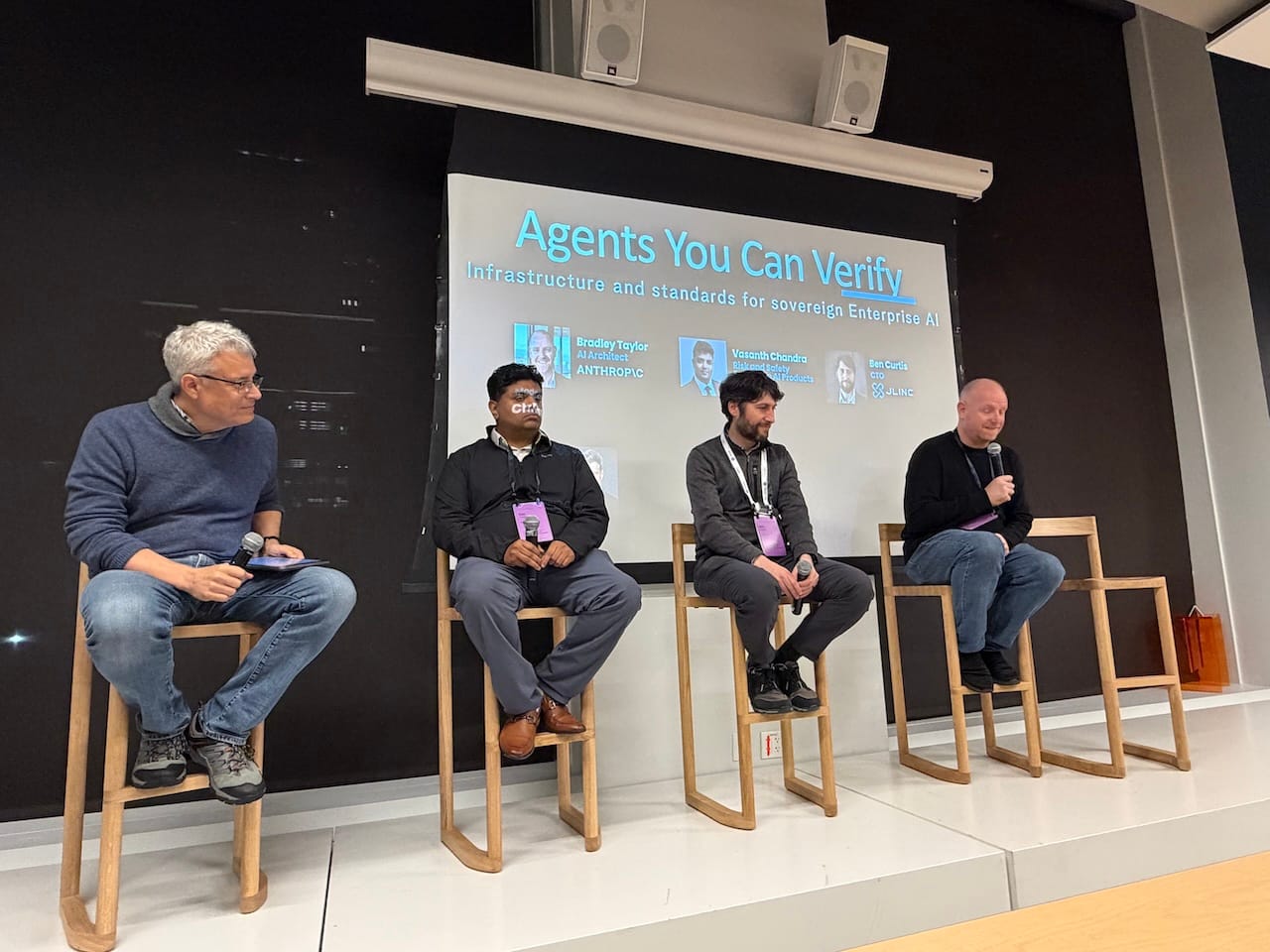
The room was engaged, the questions were sharp, and the conversation was as honest as any we’ve had on this topic. Our speakers addressed the problem from three directions:
- Vasanth Chandra, Enterprise AI Products - Risk and Safety (Meta Platforms): Presented a defense-in-depth approach to agent governance and assurance. He highlighted the nuanced and challenging aspects of the governance lifecycle. First find your agents (harder than it seems), then keep reassessing risk as their capabilities change. Vasanth walked us through the complexity of these issues, from risk assessment to continuous monitoring. He emphasized the need for complete provenance and chain-of-thought, as well as the need to work to "build in guardrails very, very early."
- Bradley Taylor - AI Architect at Anthropic (speaking for himself) presented “A Receipt For Every AI Result -building enterprise AI sovereignty you can verify.” His question for the night was simple: If an agent did something, could you prove it? He delivered the topic with a very engaging animated slide show that was fun to follow. It started by illustrating a made-up scenario where an agentic payment went super wrong for a company. They have plenty of logs and a good story, but no proof. Then came four questions from their legal department: Who made the call? Who handed what to whom? What did it see right then? Can you show that nobody touched the record afterward? He explained what can be proven with today’s verification tools: signed model files, confidential computing, content credentials, signed agent identities, and telemetry, plus early research into proving which model produced a response. Each is solid, he said, but together they are Swiss cheese, and legal’s four questions pass straight through the holes. His proposal: a receipt for every action, written as it happens and verifiable by an outsider. He left us with a bigger question, asking the room what belongs on that receipt, and by calling for a standard so that regulated work can adopt agents with confidence.
- Ben Curtis, our CTO at JLINC presented “Establishing Trust By Not Trusting”, showing how JLINC protocol governs data.sharing in agentic systems and produces the kind of receipt Bradley’s talk called for. He contrasted current agentic observability and governance methods with the JLINC tamper-evident data protocol, which provides governance through cryptographically signed Verifiable Contractual Agreements (VCAs). VCAs link human-readable agreements to machine-readable permissions and each data sharing action under the VCA produces an instant third-party audit receipt without exposing the underlying data. This Zero-Knowledge Audit (ZKA) receipt with VCA is a strong trust and compliance method and provides the speed and low-latency needed to scale with enterprise agents.
Christopher Caen, COO of JLINC then skillfully took the panel through the three enterprise agentic domains: single agent in one enterprise, many agents in one enterprise, and many agents across many enterprises. He weaved together all the panelists into what felt like one of the most honest discussions on what is necessary for AI sovereignty in enterprise, accepting the limitations as we know them.
This was the first time our CTO publicly discussed and showed some of the technical capabilities behind JLINC’s VCA and how the protocol works. It produced great questions by some really smart folks, like one of the original founders of SAML 2.0 protocol.
Although not intended, the night almost felt like a launch event for us. I took the lead on organizing an event bringing high-caliber guests together to have a meaningful discussion on this topic. It was also a great way to take advantage of Ben’s IETF 127 trip to San Francisco. He is authoring the MyTerms Contract Negotiation Protocol (powered by JLINC-designed VCAs). This was our chance to have him in the room with like-minded local peers to talk about what new methodologies can be used for governance in AI. SO thank you all for coming. For more information on his IETF work: https://datatracker.ietf.org/doc/draft-curtis-myterms/
We hoped you enjoyed learning about how to build governance layers using Verifiable Contractual Agreements (VCAs) to connect contracts with authorization, along with auditing opportunities with Zero-Knowledge Audit (ZKA) records,
Let’s continue the conversation. We are available for deeper technical discussions regarding our use of the protocol, integrating our service into your use cases, and how you can leverage JLINC to govern and/or verify what agents do with sensitive data in your system. There are many ways to customize the VCA, we only highlighted one way on Wednesday night.
We are happy to talk, email us at support@jlinc.com
We are offering you a 45 day trial of the JLINC protocol. This intro environment gives developers and teams a fast way to experience our JLINC trust infrastructure by connecting endpoints, creating VCAs and generating verifiable interactions in the JLINC cloud.
here: https://www.jlinc.com/trial
Let’s bring these validated receipts home.
Our thanks again to the speakers, the AWS Builder Loft team for hosting us last minute, and Juliet Kelso of Oasis Collective for co-hosting, and most importantly to everyone who came. More events are on the way.